
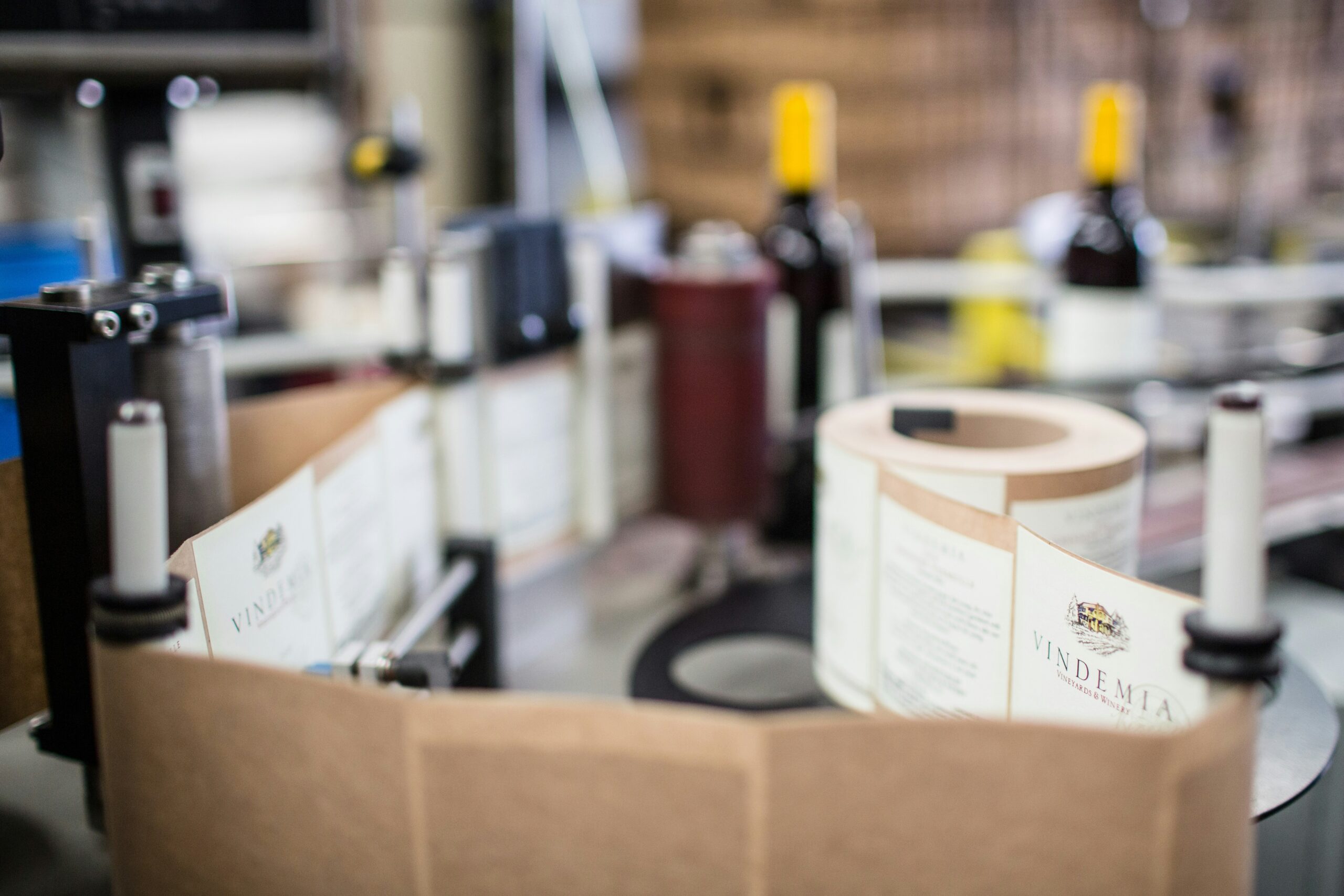
Choosing the right label printing method can have a significant impact on your cost per label, print quality, production flexibility, and long-term operating costs. The best solution depends on how many labels you need, how many colours your design requires, how often artwork changes, and whether you want to purchase pre-printed labels or print them in-house.
At IBC, we help businesses evaluate label printing options based on their application, production volume, and budget. Options range from flexographic printing for high-volume label production to digital printing for shorter runs, industrial inkjet printing for on-demand full-colour labels, and thermal transfer printing for durable product identification.
Hybrid solutions can also combine printing technologies to balance cost, flexibility, and performance.
Compare Label Printing Methods
| Printing Method | Setup Costs | Cost per Label | Colour Capabilities | Best Suited For |
|---|---|---|---|---|
| Flexographic printing | Higher initial setup; plates required for each colour | Generally lower at high volumes | Multiple colours, depending on press configuration | Large production runs and repeat orders |
| Digital label printing | Minimal plate-related setup costs | Often economical for short and medium runs | Full colour, including complex graphics | Short runs, multiple designs, and frequent changes |
| Industrial inkjet label printing | Low setup costs for new designs | Depends on ink coverage, label material, and volume | Full colour on compatible media | On-demand printing and variable information |
| Thermal transfer printing | Low setup costs | Often economical for monochrome printing | Typically one colour per print pass | Barcodes, text, product identification, and durable labels |
| Flexo + thermal transfer | Flexo plates required; thermal transfer adds a printing step | Can reduce costs when colour artwork is reused | Pre-printed colours plus variable thermal transfer printing | High-volume labels requiring changing data |
| Digital + industrial inkjet | Minimal plate-related setup costs | Depends on the equipment, media, ink, and production volume | Digital graphics combined with inkjet printing | Flexible workflows and specialized printing requirements |
Costs and capabilities vary by supplier, equipment, label material, print coverage, and order quantity. The following sections explain the trade-offs in more detail.
1. Flexographic Label Printing
Best for high-volume label production
Flexographic printing, commonly called flexo, is a conventional printing method widely used to produce labels in large quantities. It uses printing plates to transfer ink onto label material, with a separate plate generally required for each printed colour.
For water-based flexographic printing, the press applies water-based inks to compatible label materials. Once the plates are produced and the press is set up, large quantities of labels can be printed efficiently.
How Flexo Printing Costs Work
Flexo involves an upfront plate cost, but that investment can be spread across a large production run.
For budgeting purposes, plate costs may range from approximately $25–$100 per colour, depending on the supplier, plate specifications, and job requirements. This is an illustrative range rather than a fixed industry price.
For example, a four-colour label may require four printing plates. Those initial costs are added to the production cost of the labels.
As quantities increase, the plate cost is distributed across more labels, helping reduce the effective cost per label.
Advantages of Flexo Printing
- Lower cost per label at high volumes: Economies of scale can make flexo very cost-effective for large production runs.
- Consistent repeat production: Stored plates can be reused for repeat orders, subject to their condition and the printing requirements.
- Multiple colours: Suitable for brand colours, logos, product graphics, and other printed elements.
- Efficient production: Well suited to long runs and recurring label requirements.
- Broad application potential: Can be used with suitable paper and film label materials.
Considerations
- Initial plate and setup costs make short runs relatively expensive.
- Each new design or significant artwork change may require new plates.
- Multiple product versions can increase setup costs.
- Lead times may be longer when new plates must be produced.
Best fit: Businesses ordering large quantities of the same label design on a regular basis.
2. Digital Label Printing
Best for short runs, multiple designs, and changing artwork
Digital label printing produces label graphics directly from digital artwork without requiring conventional flexographic printing plates.
This substantially reduces plate-related setup costs and makes digital printing attractive for businesses that need smaller quantities, multiple product versions, or frequent design changes.
Because there is no plate charge for each colour, digital printing can be particularly useful when launching new products or producing labels for many SKUs.
Advantages of Digital Printing
- Minimal setup costs: No conventional printing plates are required.
- Full-colour graphics: Suitable for detailed artwork, logos, images, and complex designs.
- Flexible order quantities: Practical for short and medium production runs.
- Easy design changes: Artwork can be updated without manufacturing a new set of printing plates.
- Multiple SKUs: Different label versions can be produced without the plate investment associated with each flexographic design.
- Reduced obsolete inventory: Smaller print runs can help businesses avoid holding excessive quantities of labels that may become outdated.
Considerations
- The cost per label may be higher than flexo for large, repeat production runs.
- Printing costs depend on the equipment, label material, ink or toner requirements, and artwork coverage.
- Special inks, finishes, and material requirements may affect the available options and overall cost.
When Does Digital Printing Make Sense?
Digital printing is worth considering when you:
- Need several label designs in smaller quantities.
- Frequently change product information or branding.
- Want to test a new product before committing to a large print run.
- Need full-colour labels without paying for a new set of plates for every design.
Best fit: Businesses that value flexibility and low initial setup costs over the lowest possible unit cost at very high volumes.
3. Industrial Inkjet Label Printing
Best for printing full-colour labels on demand
Industrial inkjet label printers allow businesses to print labels in-house as needed. Rather than ordering finished, pre-printed labels for every design, companies can keep compatible blank label stock available and print their own graphics, text, barcodes, and variable information.
Industrial colour inkjet printers, such as the Epson ColorWorks C6000 and C8000 series, are examples of this approach. These systems are designed for colour label production, with model capabilities and media compatibility varying by printer.
Industrial colour label printer.
Advantages of Industrial Inkjet
- No conventional printing plates: New artwork can be printed without ordering a new set of plates.
- Full-colour printing: Suitable for detailed graphics, logos, and product information.
- On-demand production: Print labels when required rather than ordering every variation in advance.
- Variable data: Produce different label content, such as product names, batch information, and barcodes.
- Greater control over inventory: Reduce the need to store large quantities of finished labels for different products.
- Integration opportunities: Compatible systems can be incorporated into broader labeling and production workflows.
What Affects the Cost per Label?
Industrial inkjet printing costs depend on several factors:
- Blank label material and adhesive.
- Ink consumption and cartridge or ink system costs.
- Printed area and colour coverage.
- Label size and print resolution.
- Printer maintenance and operating requirements.
- Total production volume.
A label with a small logo and black text may cost considerably less to print than a label covered in dense, full-colour graphics. Actual costs should be evaluated using your own label artwork and expected volumes.
Industrial Inkjet vs. Digitally Printed Labels
Both approaches can provide full-colour output without conventional printing plates. The key distinction is often where and how the labels are produced.
With outsourced digital label printing, a label supplier produces the finished labels for you. With an industrial inkjet printer, your business prints labels in-house using compatible blank label stock.
In-house printing can offer greater control over timing, quantities, and changing information, while outsourced digital printing may be preferable when you need large batches of professionally finished labels without managing printing equipment yourself.
Best fit: Businesses that need full-colour labels on demand, frequent design changes, or greater control over label production.
4. Thermal Transfer Label Printing
Best for barcodes, text, and durable product identification
Thermal transfer printing uses a heated printhead and a ribbon to transfer ink onto a label. It is widely used for product identification, inventory labels, shipping labels, asset labels, and industrial applications.
Unlike conventional full-colour label printing, standard thermal transfer printers generally print one colour per print pass. Most commonly, this is black.
Some applications use two-colour printing through specialized equipment or additional printing processes, but standard thermal transfer printing should generally be considered a one-colour solution.
Industrial Thermal Transfer Printers
Advantages of Thermal Transfer Printing
- Low setup costs: No flexographic plates are needed.
- On-demand printing: Produce labels as required.
- Variable information: Easily print changing barcodes, text, dates, serial numbers, and product details.
- Durable output: Suitable ribbon and label combinations can provide resistance to abrasion, chemicals, moisture, and other environmental conditions.
- Efficient identification: Ideal for labels where readability and scanning performance are more important than full-colour graphics.
- Wide range of applications: Used in manufacturing, warehousing, shipping, retail, and inventory management.
Considerations
- Standard printers generally produce one colour per pass.
- Full-colour graphics are not practical with a conventional thermal transfer printer alone.
- Ribbon and label material must be matched to the application.
- Printing a colour logo may require pre-printed labels or an additional printing technology.
When Does Thermal Transfer Make Sense?
Thermal transfer is often a strong choice when the label primarily needs to communicate information rather than serve as full-colour packaging artwork.
Common examples include:
- Product identification labels.
- Barcode and QR code labels.
- Warehouse and inventory labels.
- Shipping and pallet labels.
- Asset tracking labels.
- Manufacturing and work-in-process labels.
Best fit: Businesses that need cost-effective, on-demand printing of variable data, barcodes, and durable identification labels.
5. Hybrid Label Printing: Flexo + Thermal Transfer
Best for combining economical colour printing with variable data
A hybrid approach combines two printing technologies to take advantage of the strengths of each.
With flexographic printing and thermal transfer, the fixed artwork is printed in advance using flexo. A thermal transfer printer then adds changing information when the labels are needed.
For example, a manufacturer may use flexo to print a label’s brand logo, background, and standard product graphics. A thermal transfer printer can then add the product-specific barcode, batch number, date, or other variable information.
How This Approach Works
- Flexo prints the standard label artwork in the required colours.
- The labels are supplied in a format compatible with the thermal transfer printer.
- The thermal transfer printer adds variable information as required.
- The completed labels are applied manually or through a compatible labeling system.
Advantages
- Lower colour-printing costs at volume: Flexo can produce the fixed artwork economically for larger quantities.
- Variable information: Thermal transfer allows product-specific data to change without redesigning the entire label.
- Reduced label variation: Standard artwork can remain consistent across different production batches.
- Flexible inventory: A common pre-printed label design can sometimes be used across multiple products, with the final information added later.
- Practical integration: Existing thermal transfer printers may be usable for the variable-data stage.
Considerations
- Pre-printed labels still require advance planning and inventory.
- The label material and printed surface must be compatible with thermal transfer printing.
- Printer registration and label positioning need to be considered.
- Two printing stages may add handling or process complexity.
Best fit: High-volume applications with consistent colour artwork but changing barcodes, batch information, product details, or dates.
6. Hybrid Label Printing: Digital + Industrial Inkjet
Best for flexible production and specialized workflows
Digital printing and industrial inkjet printing can also be combined when a business needs both professionally produced label graphics and the ability to print additional information in-house.
The exact arrangement depends on the application. For example, a business might order digitally printed labels with the main artwork already in place, then use an in-house inkjet system for an additional compatible printing step. Alternatively, outsourced digital printing may handle short-run branded labels while an industrial inkjet printer produces routine labels and variable information for other products.
Because both technologies can produce full-colour output, the purpose of combining them should be defined carefully. The goal may be to support different production volumes, materials, label formats, or workflows rather than simply to print the same content twice.
Potential Advantages
- Production flexibility: Different label requirements can be assigned to the most suitable process.
- Reduced dependence on one supplier or workflow: Some labels can be ordered externally while others are printed in-house.
- Support for multiple SKUs: Different production methods can serve different product families.
- On-demand variable information: Compatible in-house printing can add changing information when required.
- Inventory management options: Businesses can decide which labels to stock as finished products and which to produce on demand.
Considerations
- The two processes must be compatible with the selected label material and workflow.
- Printing over existing graphics requires testing for ink adhesion, print quality, and registration.
- Maintaining two systems can increase equipment, consumable, and training requirements.
- The additional stage should provide a clear operational or financial benefit.
Best fit: Businesses with varied label requirements that need both flexible digital production and in-house printing capabilities.
Which Label Printing Method Offers the Lowest Cost?
There is no single printing method that is always the cheapest. The best choice depends on the number of labels, the number of designs, the required colours, and how often information changes.
A useful starting point is to separate initial setup costs from ongoing cost per label.
General Cost Considerations
| Requirement | Method Worth Evaluating | Why |
|---|---|---|
| Large quantities of the same label | Flexographic printing | Plate costs can be spread across a large volume. |
| Small quantities of full-colour labels | Digital printing | Minimal plate-related setup costs. |
| Full-colour labels printed in-house | Industrial inkjet | Allows on-demand production without conventional plates. |
| Black barcodes and variable text | Thermal transfer | Well suited to changing data and identification labels. |
| Fixed colour artwork plus changing information | Flexo + thermal transfer | Separates economical artwork printing from variable-data printing. |
| Different label requirements across product lines | Digital + industrial inkjet | Can provide flexibility across outsourced and in-house production. |
These are general guidelines, not fixed break-even rules. The most economical method should be determined using actual quotations and operating costs.
How to Calculate Your True Cost per Label
When comparing label printing methods, consider more than the price quoted per label.
Include:
- Setup and tooling: Printing plates, artwork preparation, and initial setup.
- Label material: Face stock, adhesive, liner, and any special material requirements.
- Ink, toner, or ribbon: Consumable costs vary with printing technology and label design.
- Production volume: Larger orders can reduce unit costs, depending on the method.
- Waste and reprints: Setup waste, printing errors, and obsolete labels affect total costs.
- Inventory: Large orders may require additional storage and create the risk of outdated labels.
- Labour and handling: Consider the work involved in printing, converting, inspecting, and applying labels.
- Equipment costs: For in-house printing, account for equipment, maintenance, and ongoing operation.
For example, a flexo label with a low unit price may not be the best option if the business orders small quantities of many different designs. Conversely, printing every label digitally may not be the most economical choice for a single design used in very large quantities.
The best comparison is the total cost of producing and using the labels over time, vnot just the initial price per thousand.
Find the Right Label Printing Solution with IBC
IBC helps businesses evaluate label printing methods based on production requirements, label design, order quantities, and operating costs.
As a full-service solutions partner, we can help you assess whether pre-printed flexographic labels, digitally printed labels, industrial inkjet printing, thermal transfer printing, or a hybrid approach makes the most sense for your operation.
Our solutions can include:
- Custom barcode and product identification labels.
- Flexographic and digitally printed label options.
- Industrial colour inkjet label printers.
- Industrial thermal transfer printers and ribbons.
- Print-and-apply labeling equipment.
- Variable-data printing and barcode integration.
- Label material selection and application guidance.
- Equipment integration, support, and service.
Whether you are looking to lower your cost per label, reduce label inventory, print more information on demand, or simplify your labeling workflow, IBC can help you compare the options.
Need Help Choosing a Label Printing Method?
Email: sales@ibcworld.net
Phone: 250-493-3201
Website: www.ibcworld.net